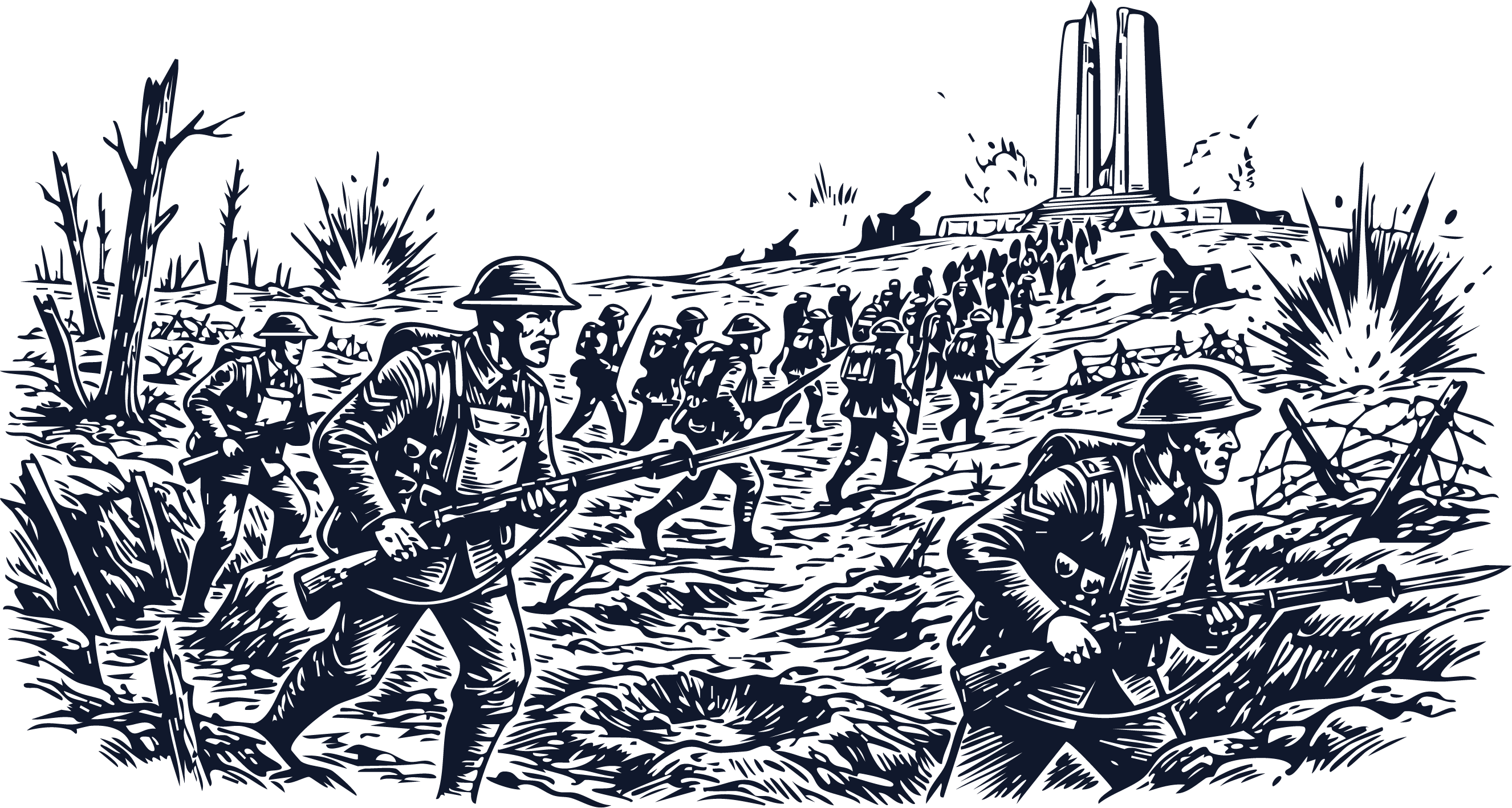
The Battle of Vimy Ridge, fought in April 1917, is the moment many Canadians point to when asked where their national identity was born. Four divisions of the Canadian Corps — fighting together as a unified force for the first time — captured a heavily fortified German position that British and French armies had failed to take for two years. The victory came at enormous cost, but it announced Canada to the world as a nation capable of achieving what others could not. For the Canadian Citizenship Test, Vimy Ridge is essential knowledge.
The Western Front Before Vimy
To understand why Vimy Ridge mattered, it helps to understand how bleak the war had become by 1917. The Western Front — a line of trenches stretching roughly 700 kilometres from Belgium to Switzerland — had been largely static since late 1914. Millions of soldiers had died for territorial gains measured in metres. The French had attempted to take Vimy Ridge twice, suffering catastrophic losses. The British had also failed. By early 1917, Vimy Ridge remained in German hands, a heavily fortified high ground overlooking the Douai Plain in northern France that provided a commanding strategic advantage.
Into this stalemate stepped the Canadian Corps The four divisions of Canadian soldiers who fought together as a unified formation on the Western Front during the First World War, under the command of General Arthur Currie from 1917. . Canada had entered the war in 1914 as a British dominion — its declaration of war was automatic when Britain declared war on Germany. But by 1917, Canadian forces had developed their own command structure, their own tactical doctrine, and a hard-won reputation as highly effective assault troops.
Planning and Preparation: A Different Kind of Attack
What distinguished the Canadian assault on Vimy Ridge was not courage — that was assumed of all soldiers on the Western Front — but preparation. General Arthur Currie and his commanders invested months in planning the attack with a rigour unusual for the era.
Every soldier was briefed on the full plan, not just their own small section of it. A detailed scale model of the ridge was built behind the lines so that troops could study the terrain they would face. Underground tunnels — some large enough to move entire battalions — were dug to allow troops to approach the front without being exposed to shellfire. Rehearsals were conducted repeatedly over ground marked to replicate the ridge’s contours.
The artillery plan was equally meticulous. Over three weeks, more than 1,000 Canadian and British guns conducted a systematic programme of counter-battery fire, targeting German artillery positions rather than simply bombarding the front lines. By the morning of the assault, roughly 80 percent of the German guns facing the attack had been silenced.
Easter Monday, April 9, 1917
The assault began at 5:30 a.m. on April 9, 1917 — Easter Monday — in a mixture of sleet and snow. All four Canadian divisions attacked simultaneously along a 6.4-kilometre front, behind a creeping barrage An artillery tactic in which a curtain of shellfire moves forward at a set pace, just ahead of advancing infantry, designed to suppress defenders and allow attackers to cross open ground. that advanced at a pace the infantry could follow.
Three of the four divisions reached their objectives that first day. The fourth — tasked with Hill 145, the highest point of the ridge and the most heavily defended — met fierce resistance and took until April 10 to secure it. A final position, known as “The Pimple,” fell on April 12. By that point, the entire ridge was in Canadian hands.
Hill 145, the ridge’s highest point, is where the Canadian National Vimy Memorial now stands. The memorial, unveiled in 1936, bears the names of 11,285 Canadian soldiers killed in France who have no known grave.
The four-day battle resulted in approximately 10,600 Canadian casualties, including 3,598 killed. Those numbers were devastating — but by the standards of the Western Front, the speed and completeness of the victory were remarkable. The Canadian Corps had taken in four days what others had failed to take in two years.
Why Vimy Ridge Became a Symbol of Canadian Nationhood
The battle’s symbolic weight did not emerge immediately — it accumulated over subsequent decades. Several factors shaped how Canadians came to interpret Vimy Ridge as a founding moment.
First, it was the first time all four Canadian divisions fought together as a single, coordinated force. Before Vimy, Canadian units had fought alongside British formations without a unified national command. At Vimy, Canada fought as Canada.
Second, the victory was attributed — fairly or not — to distinctly Canadian qualities: the thorough preparation, the trust placed in ordinary soldiers, the willingness to adapt tactics rather than repeat failed methods. Whether or not this narrative oversimplifies the reality, it gave Canadians a story about themselves that differed from simply being loyal subjects of the British Empire.
Third, the scale of the loss created a shared grief that crossed provincial and ethnic lines. English-speaking and French-speaking Canadians fought at Vimy together. Soldiers from every province were represented. So too were Indigenous Canadians, who served in significant numbers despite facing discrimination at home — a complexity that later generations have worked to acknowledge more fully.
The Vimy Memorial and National Commemoration
Canada secured the land where the battle was fought as a permanent memorial site. The Canadian National Vimy Memorial, designed by sculptor Walter Seymour Allward, took eleven years to build and was unveiled by King Edward VIII on July 26, 1936, in the presence of French President Albert Lebrun and an estimated crowd of 50,000 people, including thousands of Canadian veterans.
The memorial is built on Hill 145 — the highest and hardest-won point of the battle — and dominates the surrounding plain. Two tall pylons represent Canada and France. The centrepiece figure, a draped female form known as “Canada Bereft,” looks south over the graves of the fallen. The names carved into the base are those of Canadian soldiers killed in France with no known burial place.
The site is Canadian territory — formally ceded in perpetuity by France in gratitude for Canada’s contribution to the war. Vimy Ridge is maintained by Veterans Affairs Canada, and April 9 is observed annually as Vimy Ridge Day.
The land on which the Vimy Memorial stands was granted to Canada by France in 1922 and is legally Canadian territory. It is one of very few pieces of foreign soil that belongs permanently to Canada.
Vimy Ridge and the Path to Canadian Autonomy
The First World War accelerated Canada’s transition from British dominion to independent nation. Prime Minister Robert Borden, emboldened by Canada’s military contributions — Vimy foremost among them — argued at the 1917 Imperial War Conference that the dominions deserved a say in imperial war policy. After the war, Canada signed the Treaty of Versailles (1919) separately from Britain, a symbolic assertion of independent nationhood.
The Statute of Westminster in 1931 formally granted legislative independence to Canada and the other dominions. The road from colony to autonomous nation ran, in part, through Vimy Ridge.
Vimy Ridge in Canadian Memory Today
The battle’s place in Canadian consciousness has not remained static. Historians and educators have increasingly examined the Vimy myth critically — asking whether the “birth of a nation” framing erases the contributions of non-Canadian Allied forces, overlooks the experiences of French Canadians who opposed conscription during the same war, or glosses over the exclusion of Indigenous, Black, and Asian Canadians from the full benefits of citizenship for which they had fought.
These conversations do not diminish Vimy’s significance — they deepen it. A national memory that can hold both pride and complexity is more honest, and ultimately more durable, than one that cannot.
Conclusion
The Battle of Vimy Ridge endures as a touchstone of Canadian identity not because it was simply a military victory, but because of what it has come to represent: a young country asserting itself on the world stage, paying an enormous price, and emerging with a clearer sense of who it was and what it might become. For anyone preparing for the Canadian Citizenship Test, Vimy Ridge is not just a date and a location to memorise — it is a window into why Canada thinks about itself the way it does.
- The Battle of Vimy Ridge was fought April 9–12, 1917, during the First World War, on the Western Front in northern France.
- All four divisions of the Canadian Corps attacked together for the first time, making it a defining moment of Canadian military unity.
- The battle is seen as a symbol of Canadian nationhood — a moment when Canada distinguished itself as a nation, not merely a British dominion.
- Approximately 10,600 Canadians were casualties, including 3,598 killed over four days of fighting.
- The Canadian National Vimy Memorial stands on Hill 145, the ridge’s highest point, and bears the names of 11,285 Canadian soldiers killed in France with no known grave.
- The memorial was unveiled on July 26, 1936, and the land is legally Canadian territory, ceded permanently by France.
- April 9 is observed as Vimy Ridge Day in Canada.
- The battle contributed to Canada’s growing autonomy from Britain, culminating in the Statute of Westminster (1931), which granted Canada legislative independence.