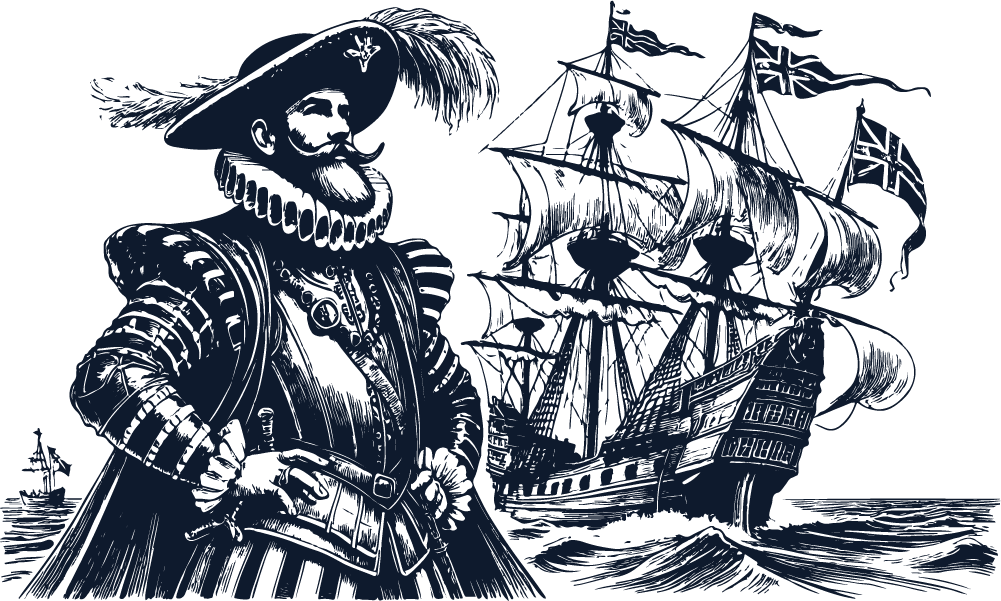
Sir Francis Drake stands as one of the most celebrated figures in British history, renowned for his daring exploits on the high seas, his significant contributions to England’s naval supremacy, and his role in defeating the Spanish Armada. This blog post delves into the life of Sir Francis Drake, exploring his early years, his pivotal voyages, and his lasting legacy in British history.
Early Life and Rise to Prominence
Francis Drake was born around 1540 in Tavistock, Devon, England, into a relatively modest family. His father, Edmund Drake, was a farmer and preacher, and it was Francis’ early exposure to the sea that sparked his passion for maritime life. At a young age, Drake was apprenticed to a sea captain who traded along the coast of England and across the English Channel, providing him with the skills he would later use to embark on more ambitious voyages.
Drake’s early career saw him involved in voyages to the Americas, where he began his infamous career as a privateer An armed ship or person (sailor) authorized by a government to attack and capture enemy vessels, especially merchant ships. . Privateers were sailors authorized by their government to attack enemy ships and claim their cargo. Drake’s privateering ventures primarily targeted Spanish ships and colonies in the Caribbean, which would become a central theme throughout his career.
First Major Voyage: Panama and the Pacific Ocean
Drake’s first major expedition took place in the 1570s when he set sail to the Americas to raid Spanish holdings. In 1572, he launched an ambitious raid on the Isthmus of Panama, where Spain had established a key trade route for transferring gold and silver from South America to Europe.
Despite facing fierce resistance, Drake managed to capture a significant amount of treasure from Spanish convoys. However, it was during this raid that he first glimpsed the Pacific Ocean from atop a hill in Panama, vowing to return and sail its waters, a promise he would later fulfill.
Circumnavigation of the Globe: Drake’s Most Famous Voyage
In 1577, Queen Elizabeth I granted Drake a commission to embark on what would become his most famous expedition: the circumnavigation of the globe. This voyage was not just a daring feat of exploration but also a covert mission to disrupt Spanish dominance in the Pacific and seize their treasure.
The Journey Begins
Drake set sail in December 1577 with five ships, the flagship being the Golden Hind (formerly the Pelican). His journey took him across the Atlantic Ocean, down the coast of South America, and through the perilous waters of the Strait of Magellan. Once he entered the Pacific Ocean, Drake began raiding Spanish ships along the coast of present-day Chile and Peru, amassing significant treasure.
Completing the Journey
After failing to find a Northwest Passage, he turned westward across the Pacific, stopping at the Spice Islands (modern-day Indonesia). From there, he navigated the Indian Ocean, rounded the Cape of Good Hope, and eventually returned to England in 1580.
The Defeat of the Spanish Armada
One of Sir Francis Drake’s most significant contributions to British history was his role in defeating the Spanish Armada in 1588. The Spanish Armada was a fleet of 130 ships sent by King Philip II of Spain to invade England and overthrow Queen Elizabeth I.
The Battle of Gravelines
When the Armada finally arrived in July 1588, Drake served as vice admiral. The English used their superior maneuverability and firepower to force the Spanish fleet into disarray. Ultimately, the Armada was defeated by a combination of naval tactics and unfavorable weather conditions.
Drake’s Legacy and Controversies
Sir Francis Drake’s legacy is a complex one. While celebrated as a national hero, his activities often blurred the line between naval warfare and piracy. Furthermore, his involvement in the transatlantic slave trade in the 1560s is a fact that tarnishes his legacy and is an important part of the historical record.
Knighthood and Honors
Despite these controversies, Drake was knighted by Queen Elizabeth I aboard the Golden Hind in 1581. He died of dysentery in 1595 during a campaign in the Caribbean and was buried at sea in a lead-lined coffin.
Key Things to Remember for the Test
- Circumnavigation: He was the first Englishman to circumnavigate the globe (1577–1580).
- The Golden Hind: This was the name of his famous flagship.
- Spanish Armada: He played a pivotal role as Vice Admiral in the 1588 defeat of the Spanish fleet.
- Knighthood: He was knighted by Queen Elizabeth I.