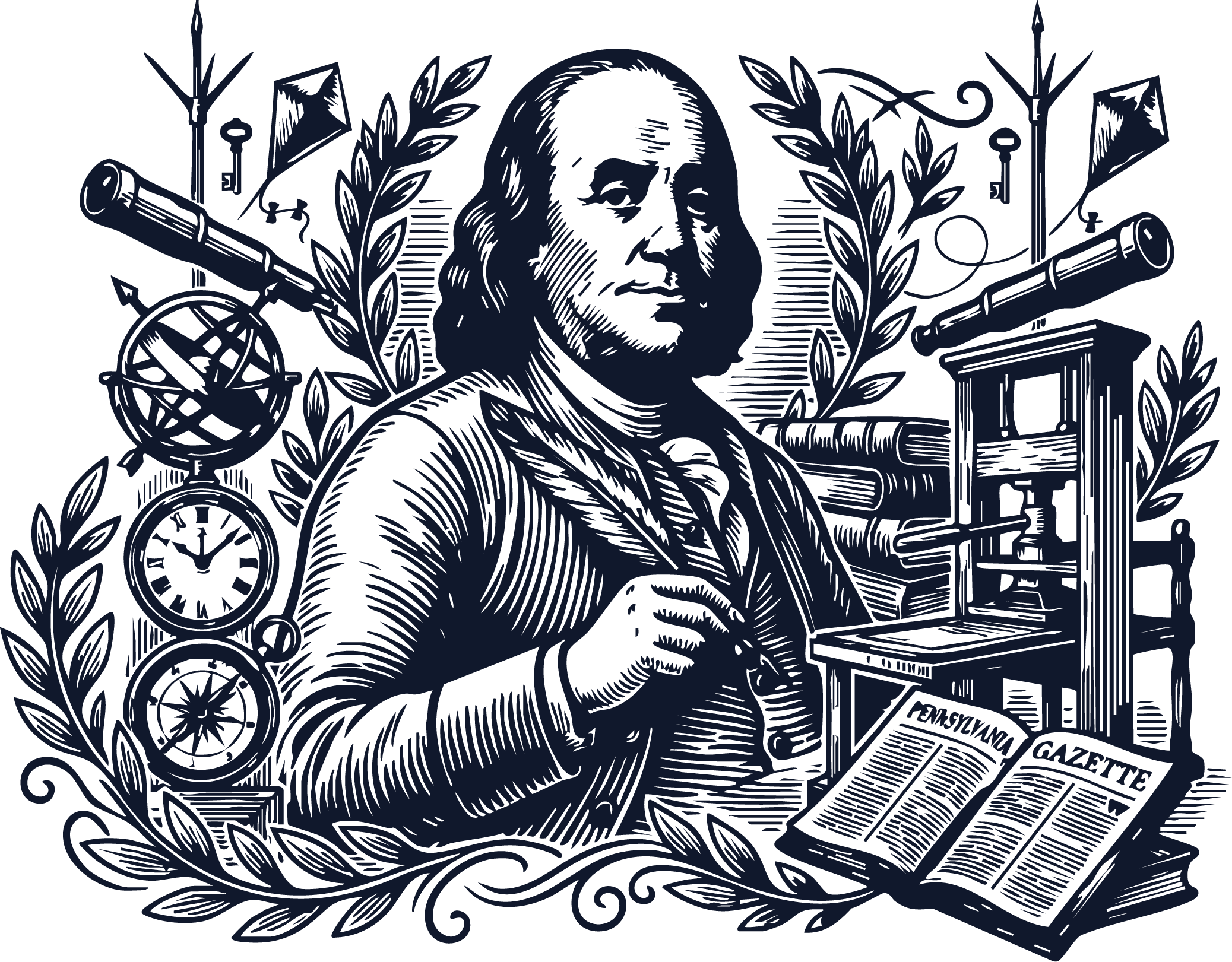
Benjamin Franklin is one of the most recognizable names in American history — yet most people know him only as the man who flew a kite in a thunderstorm. The real Franklin was far more consequential: a self-made polymath who helped draft the Declaration of Independence, negotiated the alliance with France that turned the tide of the Revolutionary War, and shaped the United States Constitution. For the US Naturalization Civics Test, understanding who Franklin was and what he contributed is essential.
From Candle-Maker’s Son to Colonial Statesman
Benjamin Franklin was born on January 17, 1706, in Boston, Massachusetts, the fifteenth of seventeen children in a working-class family. His father, Josiah Franklin, made soap and candles. Formal schooling ended for Franklin at age ten — the family could not afford more — yet he taught himself to read widely, write with precision, and argue persuasively. That self-education would define his entire life.
At twelve, Franklin was apprenticed to his older brother James, a printer. He read everything that passed through the print shop and began writing anonymously under the pen name “Silence Dogood” — a fictional middle-aged widow whose letters satirised Boston society. When James discovered the ruse, the relationship soured. At seventeen, Franklin ran away to Philadelphia, arriving with almost nothing. He never really left. Philadelphia became the city he transformed, and Pennsylvania the colony he represented on the world stage.
Printer, Publisher, and Public Intellectual
Franklin’s first career was in printing and publishing. By his mid-twenties he owned the Pennsylvania Gazette, one of the most widely read newspapers in the colonies. In 1732 he began publishing Poor Richard’s Almanack under the pen name Richard Saunders. The almanac ran for 25 years and reached a readership of roughly 10,000 per year — enormous for the time. Many of its proverbs entered everyday American speech: “An ounce of prevention is worth a pound of cure,” and “Early to bed and early to rise, makes a man healthy, wealthy, and wise.”
Franklin retired from active printing in 1748, wealthy enough to devote himself to science and public service. His printing fortune funded everything that followed — and it was a fortune earned entirely through his own enterprise, without the inherited land or social rank that underpinned most colonial wealth.
Scientist and Inventor
Franklin’s scientific work was not a hobby — it earned him international recognition during his lifetime. His experiments with electricity in the late 1740s and 1750s established foundational principles that are still taught today.
The kite experiment — which demonstrated that lightning is electrical in nature — led directly to the invention of the lightning rod, a practical device that saved countless buildings and lives. The Royal Society of London awarded Franklin its Copley Medal in 1753, its highest scientific honour. He was elected a Fellow of the Royal Society and later received honorary degrees from Harvard, Yale, Oxford, and St Andrews.
Beyond electricity, Franklin invented bifocal glasses, the flexible urinary catheter, and the Franklin stove — a more efficient wood-burning heating device. He was also the first to chart and name the Gulf Stream, useful knowledge for transatlantic navigation. In an era before patents were routine, Franklin refused to patent any of his inventions, believing they should be freely available for public benefit.
Civic Leader in Philadelphia
Franklin understood that individual achievement meant little without a functioning community. In Philadelphia he founded or co-founded several institutions that still exist today: the Library Company of Philadelphia (1731), one of America’s first public libraries; the American Philosophical Society (1743); the Academy that became the University of Pennsylvania (1749); and the Pennsylvania Hospital (1751), the first hospital in the colonies.
He also reorganised the Philadelphia post office so effectively that it turned a profit for the first time, and his methods became the model for the colonial postal service — for which he was appointed joint Postmaster General in 1753.
Franklin’s civic projects were deliberately designed to be self-sustaining. He structured the Library Company as a subscription service, the Hospital as a public-private partnership, and the Academy with a diversified funding base — institutional thinking well ahead of its time.
Franklin and the Road to Revolution
Franklin spent much of the 1750s and 1760s in London as a colonial agent, first for Pennsylvania and eventually for Georgia, New Jersey, and Massachusetts. He moved in elite British scientific and intellectual circles and genuinely hoped for reconciliation between Britain and the colonies.
His position shifted when he appeared before the House of Commons in 1766 to argue successfully against the Stamp Act A 1765 British law that imposed direct taxes on printed materials in the American colonies, widely seen as taxation without representation. — the testimony that made him famous on both sides of the Atlantic. But the passage of the Townshend Acts and, later, the Coercive Acts convinced him that Parliament had no intention of treating the colonies as equals. He returned to Philadelphia in 1775, days after the battles of Lexington and Concord had already begun.
At sixty-nine — older than almost every other Founding Father — Franklin threw himself into the independence movement. He served on the five-man committee appointed by the Second Continental Congress to draft a declaration of independence. The committee included Thomas Jefferson, John Adams, Roger Sherman, and Robert Livingston. Jefferson wrote the first draft; Franklin and Adams made revisions. Franklin’s most famous edit was small but telling: he changed Jefferson’s phrase “sacred and undeniable” truths to “self-evident” — a tighter, more philosophical formulation.
Diplomat in Paris: The Alliance That Won the War
Franklin’s most consequential contribution to American independence may not be the Declaration at all — it was the French alliance. In late 1776, Congress sent him to Paris as its chief diplomat. He was already famous there; his electrical experiments had made him a celebrity in French scientific circles, and his image had been reproduced on medallions, snuffboxes, and portraits across the country.
Franklin played the French court with extraordinary skill. He cultivated the image of a plain-spoken American philosopher — wearing a simple fur hat rather than a powdered wig — in a court that found the Rousseauian ideal of natural virtue deeply fashionable. Behind the image was hard diplomatic work. He negotiated the Treaty of Alliance of 1778, which brought France formally into the war on the American side, providing money, troops, naval power, and the strategic pressure that forced Britain to fight on multiple fronts.
In 1783, Franklin negotiated the Treaty of Paris, which formally ended the war and secured British recognition of American sovereignty. He did so alongside John Adams and John Jay, and over the objections of France, which had hoped for a less favourable settlement for Britain. The final treaty was a diplomatic triumph.
The Constitution and Franklin’s Final Years
Franklin returned to Philadelphia in 1785 at seventy-nine, the oldest delegate at the Constitutional Convention of 1787. He was too frail to deliver his own speeches — they were read aloud by James Wilson — but his presence lent the proceedings enormous legitimacy, and his willingness to compromise helped hold the convention together at several critical moments.
On the final day of the convention, Franklin delivered a speech urging every delegate to sign the Constitution despite its imperfections. “I confess,” he said, “that there are several parts of this Constitution which I do not at present approve of, though I am not sure I shall never approve them.” The appeal to humility and collective wisdom helped carry the document to ratification.
In his final years, Franklin served as President of the Pennsylvania Abolition Society and submitted a petition to Congress in 1790 calling for the abolition of slavery — one of the last acts of his public life. He died on April 17, 1790, at eighty-four. Twenty thousand people attended his funeral in Philadelphia.
Why Benjamin Franklin Matters for the US Naturalization Civics Test
The US Naturalization Civics Test asks applicants to identify the Founding Fathers and understand their contributions. Benjamin Franklin appears on the official list of Founding Fathers, and questions about his role — as a drafter of the Declaration of Independence, as a diplomat, and as a delegate to the Constitutional Convention — are within scope. His name also appears in questions about colonial history, the American Revolution, and the formation of the US government.
More broadly, Franklin’s life embodies the civic values the naturalization process asks applicants to affirm: public service, the pursuit of knowledge, institutional responsibility, and the idea that national identity is built through collective effort rather than inherited privilege.
Conclusion
Benjamin Franklin’s life resists reduction to a single story. He was a printer, scientist, civic founder, diplomat, and constitutional architect — each role significant enough to define a lesser person’s entire legacy. For anyone studying for the US Naturalization Civics Test, Franklin is not just a name to memorise. He is a lens through which to understand how the United States came to exist and what it aspired to be.
- Born January 17, 1706 in Boston, Massachusetts; died April 17, 1790 in Philadelphia, Pennsylvania.
- One of the Founding Fathers — a term for the leaders who shaped American independence and the early republic.
- Helped draft the Declaration of Independence (1776) as part of the five-member Committee of Five; Thomas Jefferson wrote the first draft.
- Negotiated the Treaty of Alliance with France (1778), bringing France into the Revolutionary War on the American side — a turning point in the conflict.
- Negotiated the Treaty of Paris (1783), which formally ended the Revolutionary War and secured British recognition of American independence.
- Delegate to the Constitutional Convention (1787), where he was the oldest participant and helped broker compromise to ensure the Constitution was signed.
- Inventor of the lightning rod and bifocal glasses; his electricity experiments earned him international scientific recognition.
- Founded key American institutions, including what became the University of Pennsylvania and the first public library in America.